Esther Chapter 1
Queen Vashti defies Ahasuerus
1 In the days of Ahasuerus, who reigned from India to Ethiopia over 127 provinces,
2 after King Ahasuerus had established himself on the throne of his kingdom in Susa, the capital of the kingdom,
3 in the third year of his reign he gave a banquet for all his princes and officials. The most powerful men of Persia and Media, governors and princes of the provinces were before him,
4 to display the riches and glory of his kingdom and the splendor and magnificence of his power for a total of 180 days.
5 When these days were over, the king gave another banquet for seven days in the courtyard of the garden of the royal palace for all the people of Susa, both great and small, who were living in the capital of the kingdom.
6 The canopy was white, green, and blue, draped with cords of fine linen and purple, with silver rings and marble pillars. The couches were of gold and silver, on a pavement of porphyry, marble, alabaster, and jacinth.
7 They served drinks in gold goblets, each different from the other, and plenty of the royal wine, according to the king’s generosity.
8 The drinking was according to this rule: No one was to be compelled to drink; for the king had so commanded all the stewards of his house, that it should be done according to each person’s desire.
9 Queen Vashti also gave a banquet for the women in the royal palace of King Ahasuerus.
10 On the seventh day, when the king was merry with wine, he commanded Mehuman, Biztha, Harbona, Bigtha, Abagtha, Zethar, and Carcas, the seven eunuchs who served King Ahasuerus,
11 to bring Queen Vashti before the king wearing her royal crown, to show her beauty to the people and the princes, for she was beautiful.
12 But Queen Vashti refused to appear at the king’s command sent by the eunuchs; and the king was very angry, and his anger burned.
13 Then the king consulted the wise men who understood the times (for this was the king’s custom with all who knew the law and justice;
14 and standing beside him were Carshena, Shethar, Admatha, Tarshish, Meres, Marsena, and Memucan, seven princes of Persia and Media who saw the king’s face and sat as the chief priests of the kingdom);
15 He asked them what should be done about Queen Vashti according to the law, since she had not obeyed the command of King Ahasuerus sent by the eunuchs.
16 And Memucan said before the king and the princes, “Queen Vashti has sinned not only against the king, but against all the princes and against all the people who are in all the provinces of King Ahasuerus.”

17 For this deed of the queen will reach the ears of all the women, and they will despise their husbands, saying, “King Ahasuerus commanded Queen Vashti to be brought before him, and she did not come.”
18 Then the ladies of Persia and Media, who hear of the queen’s deed, will tell all the king’s princes, and there will be much contempt and anger.
19 If it pleases the king, let a royal decree be issued by Your Majesty and let it be written among the laws of Persia and Media, so that it may not be transgressed: Vashti shall no longer appear before King Ahasuerus; and let the king make another queen who is better than she.
20 And the decree that the king issues shall be proclaimed throughout his vast kingdom, and all the women shall honor their husbands, from the greatest to the least.
21 This advice pleased the king and the princes, and the king did as Memucan had said.
22 For he sent letters to all the king’s provinces, to each province according to its script, and to each people according to their language, saying that every man should assert his authority in his own house; and that this should be published in the language of his people.
Esther Chapter 2
Esther is proclaimed queen
1 After all this had happened, King Ahasuerus’ anger had subsided, and he remembered Vashti and what she had done, and the sentence against her.
2 So the king’s servants, his attendants, said, “Let beautiful young virgins be sought for the king.
3 Let the king appoint officers in all the provinces of his kingdom to bring all the beautiful young virgins to the palace in Susa, to the harem, under the care of Hegai, the king’s eunuch, who is in charge of the women, and to provide them with their jewelry.
4 Then let the young woman who pleases the king reign in place of Vashti.” This pleased the king, and he did so.
5 Now there was a Jewish man living in the palace in Susa whose name was Mordecai son of Jair, the son of Shimei, the son of Kish, a Benjamite.
6 He had been taken captive from Jerusalem with the captives who had been taken with Jeconiah king of Judah, whom Nebuchadnezzar king of Babylon had taken captive.
7 He had brought up Hadassah, that is, Esther, his uncle’s daughter, for she was an orphan; and the young woman was beautiful in form and appearance. When her father and mother died, Mordecai adopted her as his own daughter.
8 Now it happened, when the king’s command and decree were made known, and many young women were gathered together in Susa, the royal residence, under the charge of Hegai. Esther also was taken into the king’s palace, under the care of Hegai, the keeper of the women.
9 The young woman pleased him, and he found favor in her sight, so he quickly provided her with jewelry and food, and also gave her seven special maids from the king’s palace. He brought her and her maids to the best quarters of the women.
10 Esther did not reveal her people or her family background, because Mordecai had instructed her not to.
11 Every day Mordecai walked back and forth in front of the courtyard of the harem to find out how Esther was doing and how she was being treated.
12 When the time came for each young woman to go to King Ahasuerus, after they had been under the ordinance for twelve months—for this was the period of their preparation: six months with oil of myrrh and six months with perfumes and cosmetics—
13 then the young woman would go to the king in this state. Whatever she asked for was given to her, so that she could go from the harem to the king’s palace adorned.
14 She would go in the evening, and early the next morning she would return to the second harem, under the care of Shaashgaz, the king’s eunuch, who was in charge of the concubines. She no longer came to the king, unless the king wanted her and she was called by name.
15 When the time came for Esther, the daughter of Abihail, Mordecai’s uncle, who had adopted her as his own daughter, to go to the king, she sought nothing but what Hegai, the king’s eunuch, who was in charge of the women, advised. And Esther won the favor of all who saw her.
16 So Esther was taken to King Ahasuerus in the tenth month, the month of Tebeth, in the seventh year of his reign.
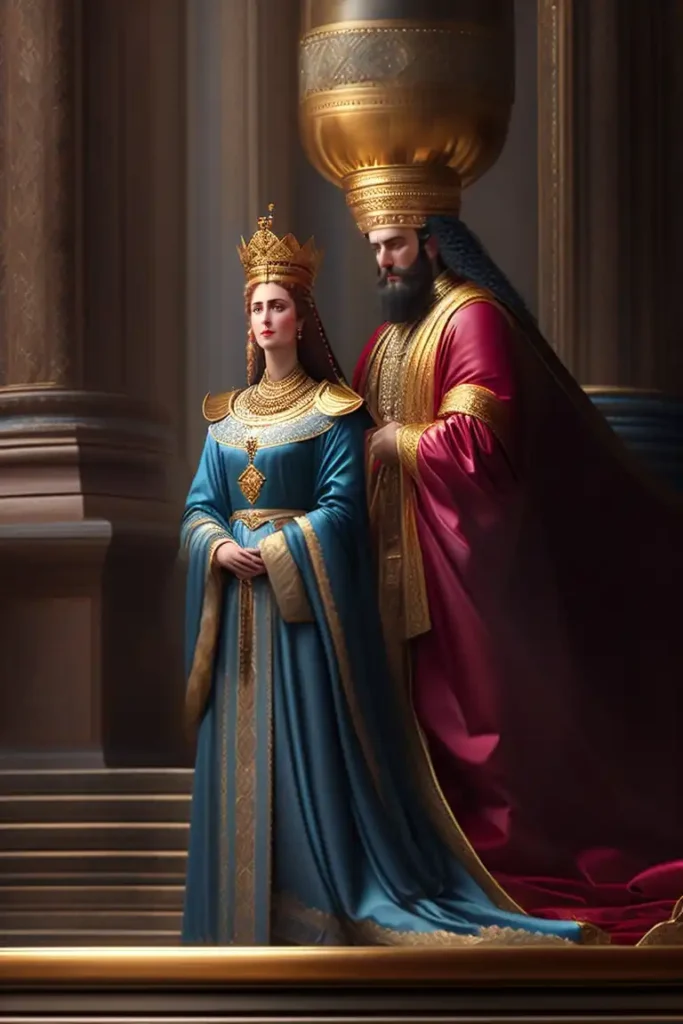
17 The king loved Esther more than all the other women, and she won his favor and grace more than all the other virgins. He placed the royal crown on her head and made her queen instead of Vashti.
18 Then the king gave a great banquet for all his princes and servants—Esther’s banquet. He also reduced the taxes levied on the provinces and made generous gifts in royal bounty.
Mordecai denounces a conspiracy against the king
19 When the virgins were gathered together for the second time, Mordecai was sitting at the king’s gate.
20 Esther, as Mordecai had instructed her, had not revealed her nationality or her people, for Esther did everything Mordecai told her, just as when he was bringing her up.
21 In those days, while Mordecai was sitting at the king’s gate, Bigthan and Teresh, two of the king’s eunuchs who guarded the gate, became angry and plotted to assassinate King Ahasuerus.
22 When Mordecai learned of this, he told Queen Esther, and Esther reported it to the king on Mordecai’s behalf.
23 An inquiry was made about the matter, and it was found to be true; therefore, the two eunuchs were hanged on a gallows. And the matter was recorded in the book of the king’s chronicles.
Esther Chapter 3
Haman plots the destruction of the Jews
1 After these things, King Ahasuerus promoted Haman son of Hammedatha the Agagite and honored him, and set his seat above all the princes who were with him.
2 And all the king’s servants who were at the king’s gate bowed down and paid homage to Haman, for the king had so commanded; but Mordecai would neither bow down nor pay homage.
3 And the king’s servants who were at the gate asked Mordecai, “Why do you transgress the king’s command?”
4 So it happened that they spoke to him day after day in this way, and he would not listen to them. So they told Haman, to see whether Mordecai would stand firm in what he said, for he had already told them that he was a Jew.
5 When Haman saw that Mordecai would neither bow down nor pay homage to him, he was filled with rage.
6 But he disdained to lay hands on Mordecai alone, for he had been told who Mordecai’s people were; and Haman sought to destroy all the Jews who were in the kingdom of Ahasuerus, the people of Mordecai.
7 In the first month, which is the month of Nisan, in the twelfth year of King Ahasuerus, Pur, that is, the lot, was cast before Haman, a lot for each day and each month of the year; and it fell on the twelfth month, which is the month of Adar.
8 And Haman said to King Ahasuerus, “There is a certain people scattered and dispersed among the peoples in all the provinces of your kingdom, and their laws are different from those of every other people, and they do not keep the king’s laws, and it is not in the king’s interest to let them live.
9 If it pleases the king, let him issue a decree that they be destroyed; and I will pay ten thousand talents of silver to the officials of the treasury, to be brought into the king’s treasury.”
10 Then the king took his signet ring from his hand and gave it to Haman son of Hammedatha the Agagite, the enemy of the Jews,
11 and said to him, “The money you are offering is yours, and the people as well, to do with them as you please.”
12 So the king’s scribes were summoned on the thirteenth day of the first month, and a decree was written, according to all that Haman had commanded, to the king’s satraps, to the governors of each province, and to the princes of each people, to each province in its own script and to each people in its own language. It was written in the name of King Ahasuerus and sealed with the king’s signet ring.

13 Letters were sent by couriers to all the king’s provinces, with the order to destroy, kill, and annihilate all the Jews—young and old, women and children—on a single day, the thirteenth day of the twelfth month, the month of Adar, and to seize their possessions.
14 A copy of the decree, which was issued in every province, was published to all the people, so that they would be ready for that day.
15 The couriers went out promptly at the king’s command, and the edict was issued in Susa, the capital of the kingdom. The king and Haman sat down to drink, but the city of Susa was in turmoil.
Esther Chapter 4
Esther promises to intercede for her people
1 When Mordecai learned of all that had been done, he tore his clothes, put on sackcloth and ashes, and went out into the city, crying out with a loud and bitter cry.
2 He came to the king’s gate, for it was not lawful for anyone to enter the king’s gate wearing sackcloth.
3 In every province and place where the king’s command and decree arrived, the Jews mourned greatly, fasting, weeping, and wailing; many lay in sackcloth and ashes.
4 Esther’s maids and eunuchs came and told her. The queen was deeply distressed and sent clothes to be made for Mordecai to take off his sackcloth, but he refused them.
5 Then Esther summoned Hathach, one of the king’s eunuchs whom he had appointed to serve her, and sent him to Mordecai to find out what was happening and why he was acting this way.
6 So Hathach went out to Mordecai in the city square before the king’s gate.
7 Mordecai told him everything that had happened to him and informed him of the money Haman had said would be weighed out for the king’s treasury in exchange for the destruction of the Jews.
8 He also gave him a copy of the decree issued in Susa for their destruction, so that he might show it to Esther and explain it to her, and instruct her to go to the king and plead with him for her people.
9 Hatach came and told Esther what Mordecai had said.
10 Then Esther told Hatach to tell Mordecai,
11 “ All the king’s servants and the people of the king’s provinces know that there is only one law concerning any man or woman who enters the inner court to see the king without being summoned: they must be put to death. Except for the one to whom the king extends the golden scepter, who will live. But I have not been summoned to see the king these thirty days.”
12 So they told Mordecai what Esther had said.
13 Then Mordecai told them to reply to Esther, “Do not think that because you are in the king’s palace you alone of all the other Jews will escape.”
14 For if you remain silent at this time, relief and deliverance for the Jews will arise from another place, but you and your father’s family will perish. And who knows but that you have come to your royal position for such a time as this?
15 Esther told them to reply to Mordecai,
16 “Go, gather together all the Jews who are present in Susa, and fast for me. Do not eat or drink for three days, night or day. My attendants and I will fast likewise. And so I will go to the king, even though it is against the law. And if I perish, I perish.”
17 So Mordecai went and did everything Esther had commanded him.
Esther Chapter 5
Esther invites the king and Haman to a banquet
1 On the third day Esther put on her royal robes and stood in the inner court of the king’s palace, opposite the king’s chamber. The king was sitting on his throne in the royal chamber, facing the entrance to the chamber.
2 When he saw Queen Esther standing in the court, she won his favor. The king held out to Esther the gold scepter that was in his hand, and she came and touched the tip of it.
3 The king said, “What is your request, Queen Esther? It will be given to you up to half the kingdom.”
4 Esther replied, “If it pleases the king, let the king and Haman come today to the banquet I have prepared for him.”
5 The king said, “Summon Haman quickly, so that we may do as Esther has said.” So the king and Haman came to the banquet Esther had prepared.
6 And the king said to Esther at the banquet, as they drank wine, “What is your petition? It shall be granted to you. What is your request? Even half the kingdom, it shall be granted to you.”
7 Then Esther answered and said, “This is my petition and my request:
8 If I have found favor in the sight of the king, and if it pleases the king to grant my petition and fulfill my request, let the king and Haman come to another banquet that I will prepare for them; and tomorrow I will do as the king has commanded.”
9 So Haman went out that day joyful and glad of heart; but when he saw Mordecai at the gate of the king’s palace, and that he neither rose nor moved from his place, he was filled with wrath against Mordecai.
10 But Haman restrained himself and went home, and sent for his friends and Zeresh his wife,
11 and Haman told them of the glory of his riches, and the multitude of his children, and all the things with which the king had exalted him, and with which he had honored him above the princes and servants of the king.

12 Haman added, “Queen Esther invited no one with the king to the banquet she prepared, except me. And tomorrow she has invited me to join the king there.
13 But all this is of no use to me, as long as I see Mordecai the Jew sitting at the king’s gate.”
14 Then Zeresh his wife and all his friends said to him, “Have a gallows built fifty cubits high, and tomorrow tell the king to hang Mordecai on it. Then he will go in with the king to the banquet in high spirits.” This pleased Haman, and he made the gallows ready.
Esther Chapter 6
Haman is forced to honor Mordecai
1 That night the king could not sleep, so he ordered the book of the chronicles to be brought in and read to him.
2 It was found written there that Mordecai had reported the plot of Bigthan and Teresh, two of the king’s eunuchs who guarded the door, who had sought to assassinate King Ahasuerus.
3 The king asked, “What honor or distinction has been bestowed on Mordecai for this?” The king’s servants, his officers, answered, “Nothing has been done for him.”
4 Then the king asked, “Who is standing in the court?” Now Haman had come to the outer court of the royal palace to speak to the king, asking him to hang Mordecai on the gallows he had prepared for him.
5 The king’s servants answered, “Haman is standing in the court.” The king said, “Let him come in.”
6 So Haman came in, and the king asked him, “What shall be done for the man whom the king delights to honor?” And Haman said to himself, “Whom would the king delight to honor more than me?”
7 So Haman said to the king, “For the man whom the king delights to honor,
8 let the royal robes that the king wears, the horse on which the king rides, and the royal crown that is on his head be brought in.
9 Then let the robes and the horse be given into the hand of one of the king’s most noble princes, and let them clothe the man whom the king delights to honor, and let them lead him on the horse through the city square, and proclaim before him, ‘Thus shall it be done to the man whom the king delights to honor!’”
10 Then the king said to Haman, “Hurry, take the robes and the horse, as you have said, and do so for Mordecai the Jew, who sits at the king’s gate; leave nothing out of all that you have said.”
11 And Haman took the robe and the horse, and clothed Mordecai, and led him on horseback through the square of the city, and made a proclamation before him, Thus shall it be done to the man whom the king delights to honor.
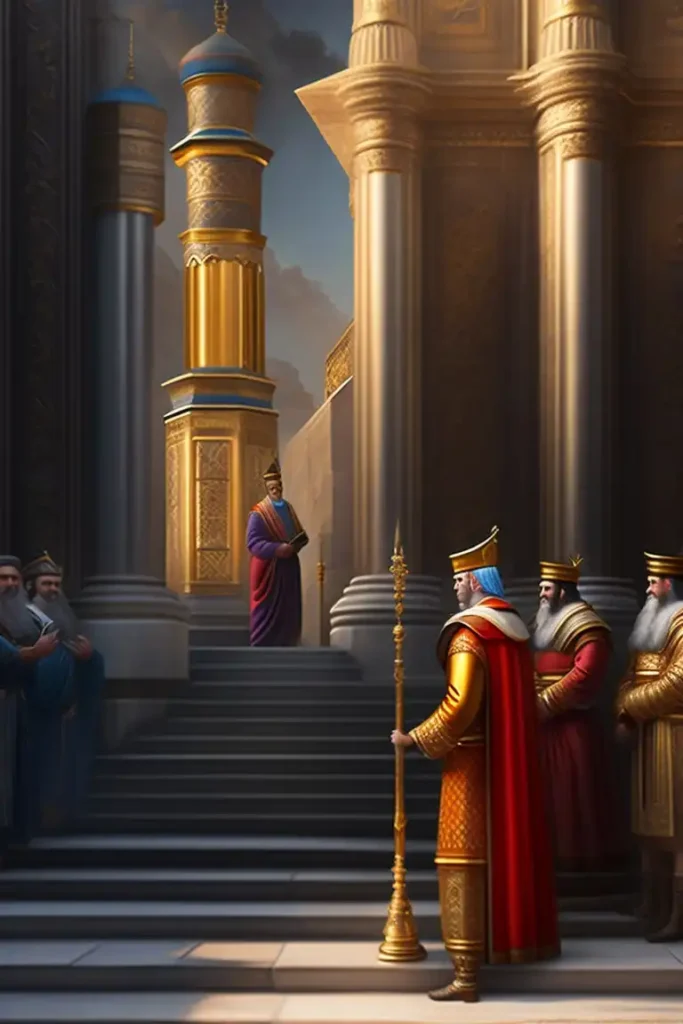
12 After this, Mordecai returned to the king’s gate, and Haman hurried home, dejected and with his head covered.
13 Then Haman told his wife Zeresh and all his friends everything that had happened to him. His wise men and his wife Zeresh said to him, “If Mordecai, before whom you have begun to fall, is of the Jewish lineage, you will not prevail against him, but will surely fall before him.”
14 While they were still talking with him, the king’s eunuchs came hurrying to escort Haman to the banquet Esther had prepared.
Esther Chapter 7
Haman is hanged
1 So the king and Haman went to the banquet of Queen Esther.
2 On the second day, while they were drinking wine, the king said to Esther, “What is your petition, Queen Esther? It shall be granted to you. What is your request? Even half the kingdom, it shall be given to you.”
3 Then Queen Esther answered and said, “O king, if I have found favor in your sight, and if it pleases the king, let my life be given me at my petition, and my people at my request.
4 For we have been sold, I and my people, to be destroyed, to be killed and annihilated. If we had been sold as male or female slaves, I would have kept silent; but our death would be a loss beyond repair to the king.”
5 King Ahasuerus answered and said to Queen Esther, “Who is this, and where is he, who has dared to do this?”
6 Esther said, “The enemy and adversary is this wicked Haman.” Then Haman was distraught before the king and queen.
7 So the king rose from the banquet in a rage and went to the palace garden. Haman remained there to plead with Queen Esther for his life, for he saw that the king was determined to bring about his downfall.
8 When the king returned from the palace garden to the banquet hall, Haman had fallen on the couch where Esther was reclining. The king said, “Will you also rape the queen in my own house?” As soon as the king said this, they covered Haman’s face.
9 Harbona, one of the king’s eunuchs, said, “Look, standing at Haman’s house is the gallows fifty cubits high that Haman made for Mordecai, because he spoke well for the king.” Then the king said, “Hang him on it.”
10 So they hanged Haman on the gallows he had prepared for Mordecai, and the king’s anger subsided.

Esther Chapter 8
Decree of Ahasuerus in favor of the Jews
1 That same day, King Ahasuerus gave Queen Esther the house of Haman, the enemy of the Jews. Mordecai came before the king because Esther had told him what he was to her.
2 The king took off his signet ring, which he had taken from Haman, and gave it to Mordecai. Esther then put Mordecai in charge of Haman’s house.
3 Esther spoke again before the king, and fell at his feet, weeping and pleading with him to abolish the evil deed of Haman the Agagite and the plot he had hatched against the Jews.
4 Then the king extended the golden scepter to Esther, and Esther arose and stood before the king.
5 She said, “If it pleases the king, and if I have found favor in his sight, and if it seems right to the king, and if I am pleasing in his eyes, let a written decree be issued to revoke the letters that authorize the plot of Haman son of Hammedatha the Agagite, which he wrote to destroy the Jews who are in all the king’s provinces.
6 For how can I bear to see the evil that will come upon my people? How can I bear to see the destruction of my nation?”
7 King Ahasuerus answered Queen Esther and Mordecai the Jew, “Behold, I have given Esther the house of Haman, and he has been hanged on a gallows, because he stretched out his hand against the Jews.
8 Therefore, write to the Jews as you see fit, in the king’s name, and seal it with the king’s signet ring; For a decree written in the king’s name and sealed with the king’s signet ring cannot be revoked.
9 So the king’s scribes were summoned on the twenty-third day of the third month, which is Sivan, and a decree was written, according to all that Mordecai had commanded, to the Jews, the satraps, the governors, and the princes of the provinces from India to Ethiopia, 127 provinces in all. The decree was written in each province’s own script and in each people’s own language, and the decree was also written in the language of the Jews.
10 He wrote it in the name of King Ahasuerus, sealed it with the king’s signet ring, and sent letters by couriers riding on swift horses from the royal pastures.
11 that the king gave authority to the Jews who were in all the cities, to assemble and be ready to defend their lives, to destroy, and kill, and annihilate any armed force of any people or province that might come against them, and even their children and women, and to seize their possessions,

12 On the same day, in all the provinces of King Ahasuerus, on the thirteenth day of the twelfth month, which is the month of Adar, the decree was issued.
13 The copy of the decree, which was to be issued by decree in every province so that it would be known to all the peoples, said that the Jews should be ready for that day to avenge themselves on their enemies.
14 So the messengers, mounted on swift horses, went out in haste at the king’s command, and the decree was issued in Susa, the capital of the kingdom.
15 Then Mordecai went out from the presence of the king wearing royal robes of blue and white, with a large golden crown and a robe of fine linen and purple. The city of Susa was then filled with joy and gladness;
16 and the Jews had light and gladness, joy and honor.
17 And in every province and in every city where the king’s command arrived, the Jews had gladness and gladness, a feast and a day of rejoicing. And many from among the peoples of the earth became Jews, because the fear of the Jews had fallen upon them.
Esther Chapter 9
The Jews destroy their enemies
1 In the twelfth month, the month of Adar, on the thirteenth day of the month, the day the king’s command and decree were to be carried out—the very day the enemies of the Jews expected to prevail against them—the opposite occurred; for the Jews prevailed over those who hated them.
2 The Jews gathered in their cities throughout all the provinces of King Ahasuerus to strike down those who had sought their harm, and no one could resist them, for the fear of them had fallen on all the peoples.
3 All the princes of the provinces, the satraps, the governors, and the king’s officers supported the Jews, for the fear of Mordecai had fallen on them.
4 For Mordecai was great in the king’s house, and his fame spread throughout all the provinces. Mordecai grew more and more powerful.
5 The Jews struck down all their enemies with the sword, killing and destroying them, and did to their enemies as they pleased.
6 In Susa, the capital of the kingdom, the Jews killed and destroyed five hundred men.
7 They killed Parsandata, Dalphon, Aspatha,
8 Porata, Adalia, Aridatha,
9 Parmashta, Arisai, Aridai, and Vaizatha,
10 the ten sons of Haman, son of Hammedatha, the enemy of the Jews; but they did not touch their possessions.
11 The king was told that same day about the number of those killed in Susa, the royal residence.
12 The king said to Queen Esther, “In Susa, the capital of the kingdom, the Jews have killed five hundred men, including ten of Haman’s sons. What have they done in the other provinces of the king? What, then, is your petition? It will be granted to you. Or what else is your request? It will be done.”
13 Esther replied, “If it pleases the king, let permission be granted to the Jews in Susa tomorrow also, according to the law of today, to hang Haman’s ten sons on the gallows.”
14 The king ordered that this be done. The decree was issued in Susa, and Haman’s ten sons were hanged.
15 The Jews who were in Susa also assembled on the fourteenth day of Adar and killed three hundred men in Susa, but they did not lay a hand on their possessions.
The Purim festival
16 As for the other Jews who were in the king’s provinces, they also gathered together and stood up for their lives and had rest from their enemies. They killed seventy-five thousand of their adversaries, but they did not lay a hand on their possessions.
17 This was on the thirteenth day of the month of Adar, and they rested on the fourteenth day of the same month and made it a day of feasting and gladness.
18 But the Jews who were in Susa gathered together on the thirteenth and fourteenth days of the same month, and on the fifteenth of the same month they rested and made it a day of feasting and gladness.
19 Therefore, the Jews who live in the unwalled villages observe the fourteenth day of the month of Adar as a day of gladness and feasting, a day of rejoicing, and a day to send portions to one another.
20 Mordecai wrote these things and sent letters to all the Jews who were in all the provinces of King Ahasuerus, both near and far,

21 instructing them to celebrate the fourteenth and fifteenth days of the month of Adar each year,
22 as days when the Jews had peace from their enemies, and as the month which was turned from sorrow into joy, and from mourning into a good day; to make them days of feasting and gladness, and to send portions to one another and gifts to the poor.
23 And the Jews agreed to do, just as they had begun, what Mordecai had written to them.
24 For Haman son of Hammedatha the Agagite, the enemy of all the Jews, had plotted against the Jews to destroy them, and had cast Pur (that is, lots) to consume them and put an end to them.
25 But when Esther came before the king, he issued a letter ordering that the wicked plot that Haman had devised against the Jews should fall on his own head, and that he and his sons should be hanged on the gallows.
26 Therefore these days were called Purim, after the name Pur. And because of the words of this letter, and because of what they saw concerning it, and what it brought to their knowledge,
27 the Jews established and took it upon themselves, their descendants, and all who were close to them, that they would not fail to celebrate these two days, as it was written concerning them, at their appointed time each year;
28 and that these days would be remembered and celebrated by all generations, families, provinces, and cities; that these days of Purim would not cease to be observed by the Jews, and that their descendants would never cease to remember them.
29 And Queen Esther, daughter of Abihail, and Mordecai the Jew, signed this second letter concerning Purim with full authority.
30 And letters were sent to all the Jews, to the 127 provinces of King Ahasuerus, with words of peace and truth,
31 to confirm these days of Purim at their appointed times, as Mordecai the Jew and Queen Esther had commanded them, and as they had taken upon themselves and their descendants, to commemorate the end of their fasting and their cry.
32 And Esther’s commandment confirmed these celebrations concerning Purim, and this was recorded in a book.
Esther Chapter 10
The Greatness of Mordecai
1 King Ahasuerus imposed a tax on the land and even to the coastlands.
2 Now all the acts of his power and authority, and the account of Mordecai’s greatness, by which the king promoted him, are they not written in the book of the chronicles of the kings of Media and Persia?
3 For Mordecai the Jew was second only to King Ahasuerus, and great among the Jews, and esteemed by the multitude of his brethren, because he sought the welfare of his people and spoke peace to all his descendants.